Gamification · Board Game Design
Solo project, gamification coursework, FLAME University
A Christmas supply chain simulation board game where players run a North Pole bakery: collect ingredients, bake, deliver, and earn Joy Points. The festive theme is the hook. Underneath it, every rule maps to a real operations constraint.
Supply chain is taught with diagrams: nodes, arrows, and a lot of vocabulary. It's the kind of subject people can describe correctly and still not feel. I wanted a game where the logic arrived through consequence instead of definition, so players would understand why a bottleneck hurts because one just cost them a round.
The design target was deliberately wide. It plays for families and children because of the Christmas theme, and it holds up for business students because the mechanics are real operations steps. No prior business knowledge is needed to play, which was the constraint that kept the rules honest. The complete rules, cards, and board are in the rule book ↓.
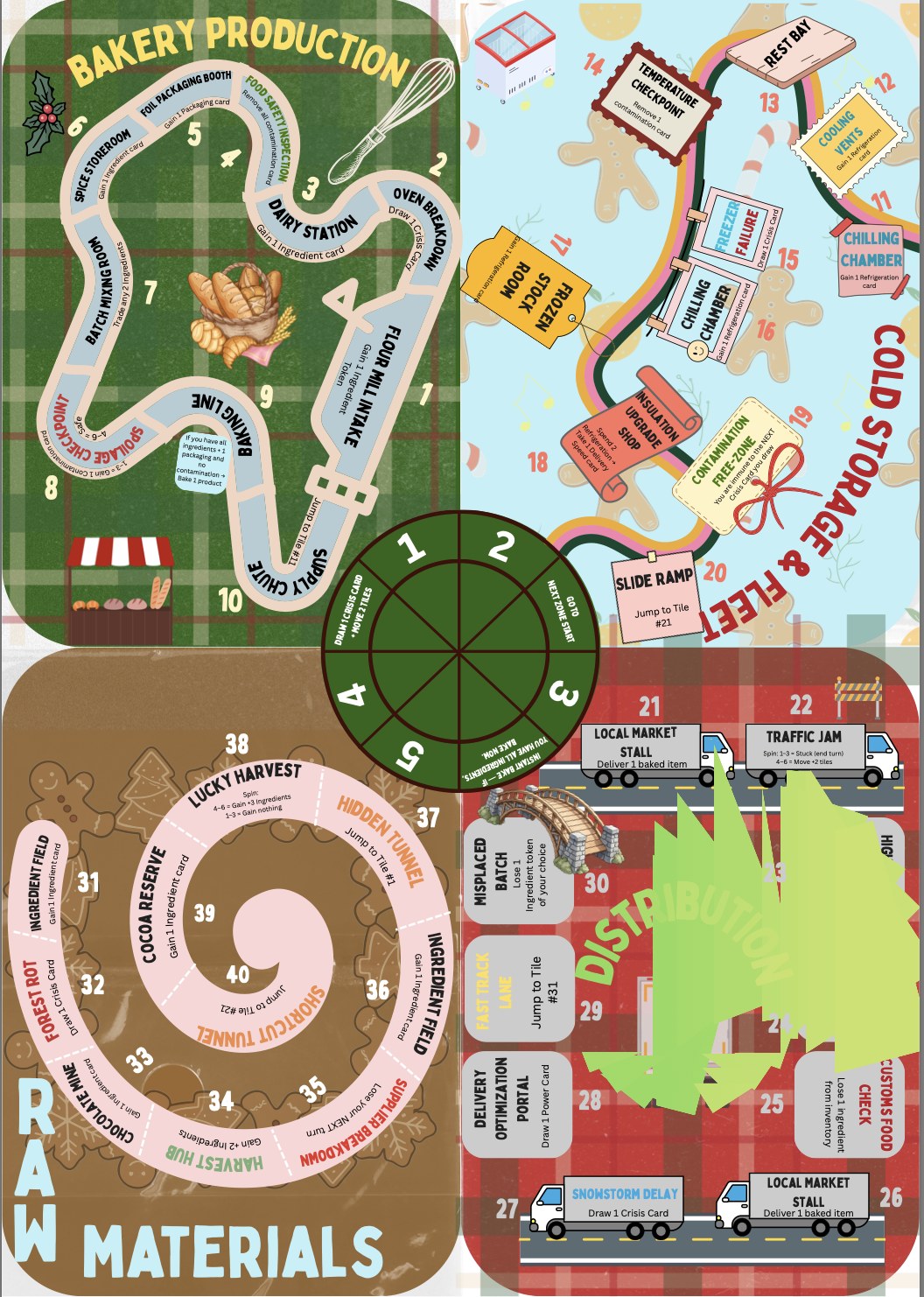
Forty tiles run in one continuous loop through four connected zones: Raw Materials, Bakery Production, Cold Storage, and Distribution. Players don't pass through once, they cycle it repeatedly, which is the point. A supply chain isn't a line you finish, it's a loop you keep running while things go wrong.
Every player starts as a supply manager at the North Pole Bakery with one Order Card, one Packaging Token, and one Character Card carrying a special ability. They start with no ingredients, no refrigeration, and no contamination. Everything else has to be earned on the board.
The core loop is collect, bake, deliver, score, and each stage has a gate. Ingredients are drawn in Raw Materials, capped at five in hand, so players have to plan around capacity rather than hoard. Baking only happens if you land exactly on the Baking Line tile with every ingredient your Order Card demands, a Packaging Token in hand, and no contamination. Miss one condition and the turn ends. You go around again.
The rule I'm most attached to is that baking earns nothing. Joy Points only come from delivery. Producing something and never getting it to anyone is the most common failure in a real supply chain, and making it worth zero teaches that faster than a lecture does. Delivery then splits into a genuine decision: a Local Delivery moves one product for the Joy Points on the card, or an Export Delivery moves up to two at once for double Joy but costs a Refrigeration Token. Cheap and safe, or expensive and leveraged.
Movement runs on a Christmas Tree spinner rather than dice, and the spinner does more than move you. It can trigger a Crisis, applied immediately, or a Zone Jump that throws you into the next zone entirely. Crisis Cards introduce contamination, lost ingredients, missed turns, and delivery delays. Power and Reward Cards push the other way with extra ingredients, contamination removal, teleports, and bonus Joy.
The tokens are where the systems thinking sits, because each one does exactly one job and refuses to do any other. Packaging is required to bake. Refrigeration is required only for export. Contamination blocks baking until it's cleared. Joy is purely score. Nothing is a universal currency, so players can be resource-rich and still completely stuck, which is the most realistic thing in the box.
It works because nobody has to know what a bottleneck is to feel one. They just know they're going around the board again because they were missing packaging, and that lands harder than the definition ever did.